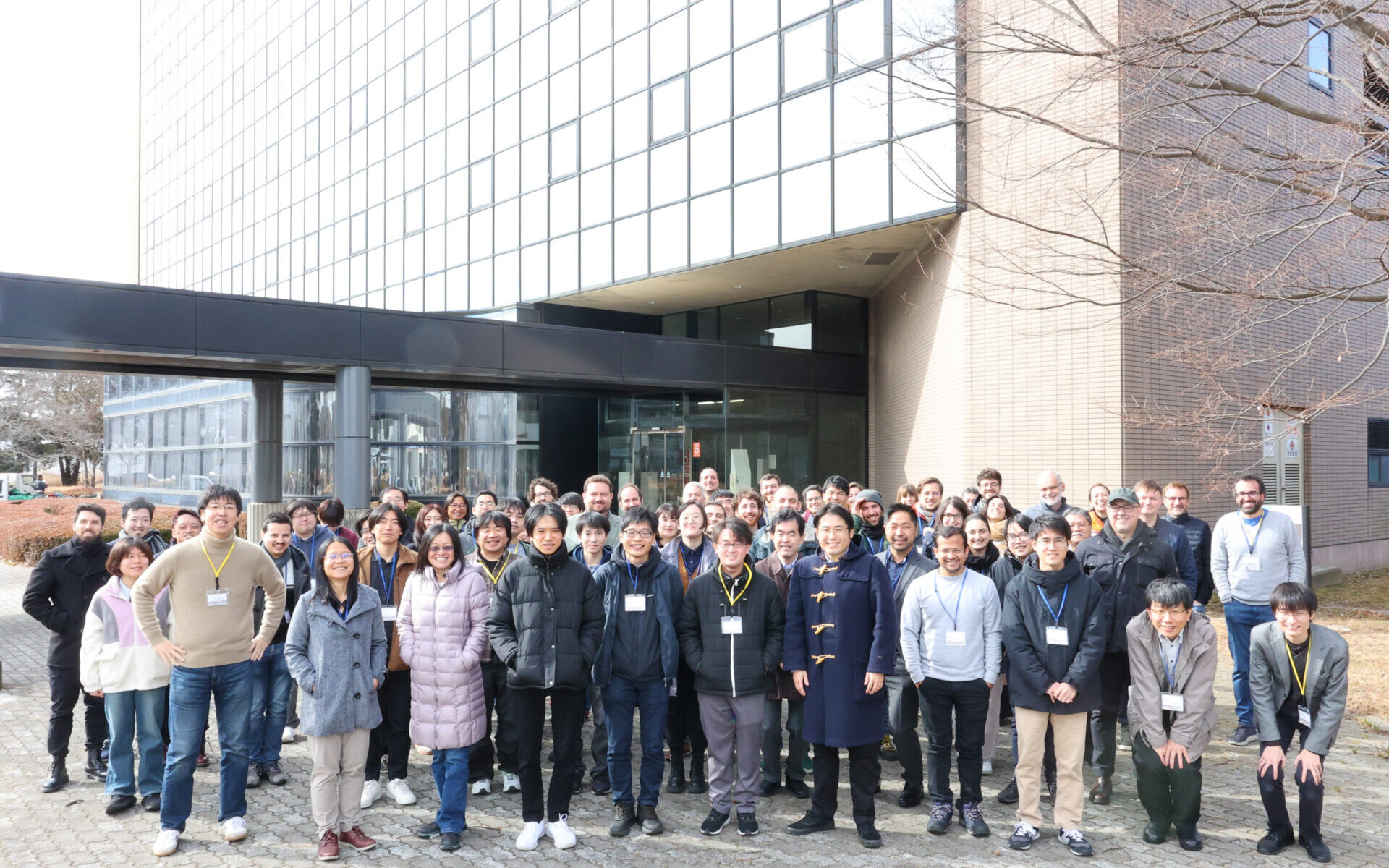
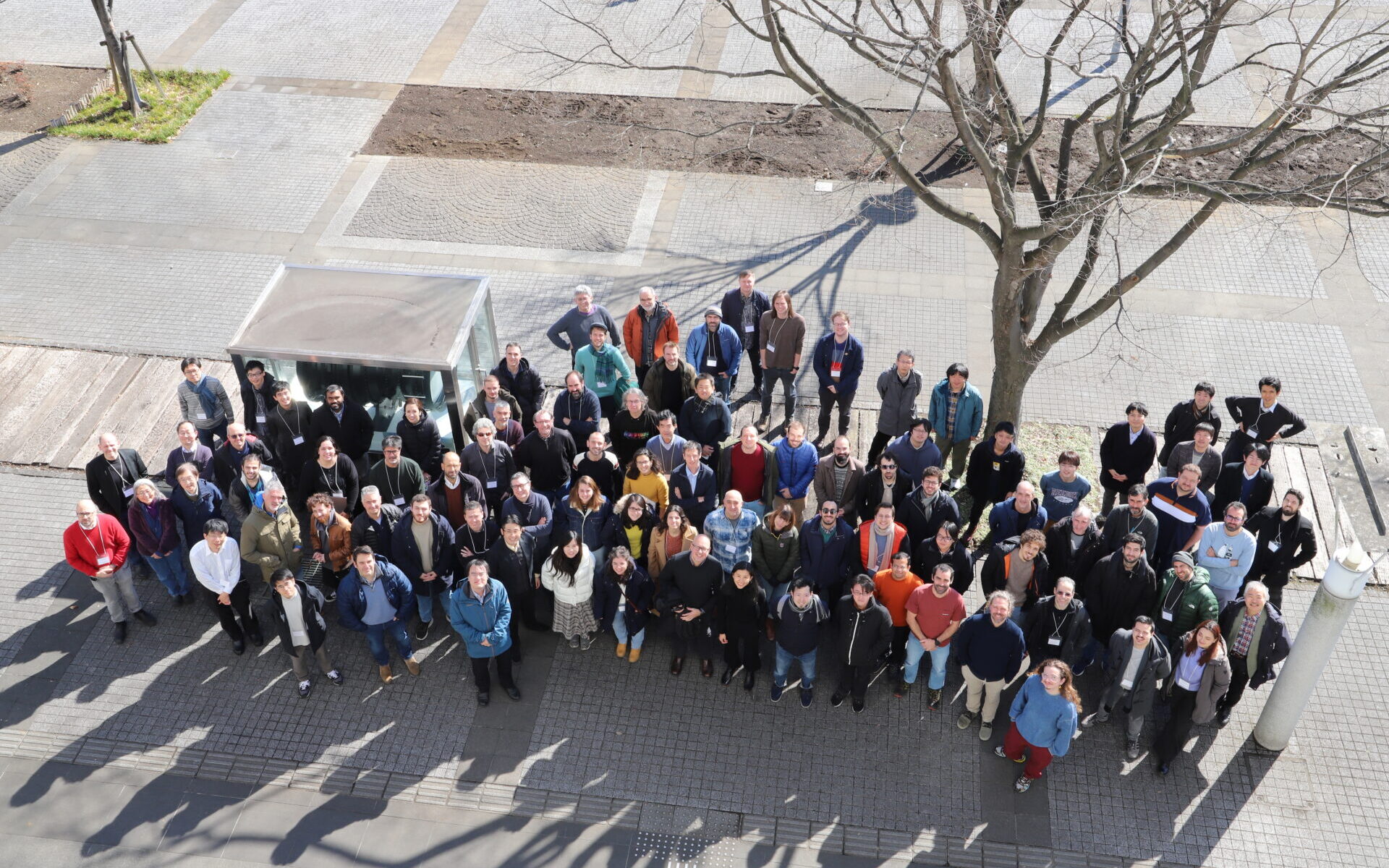
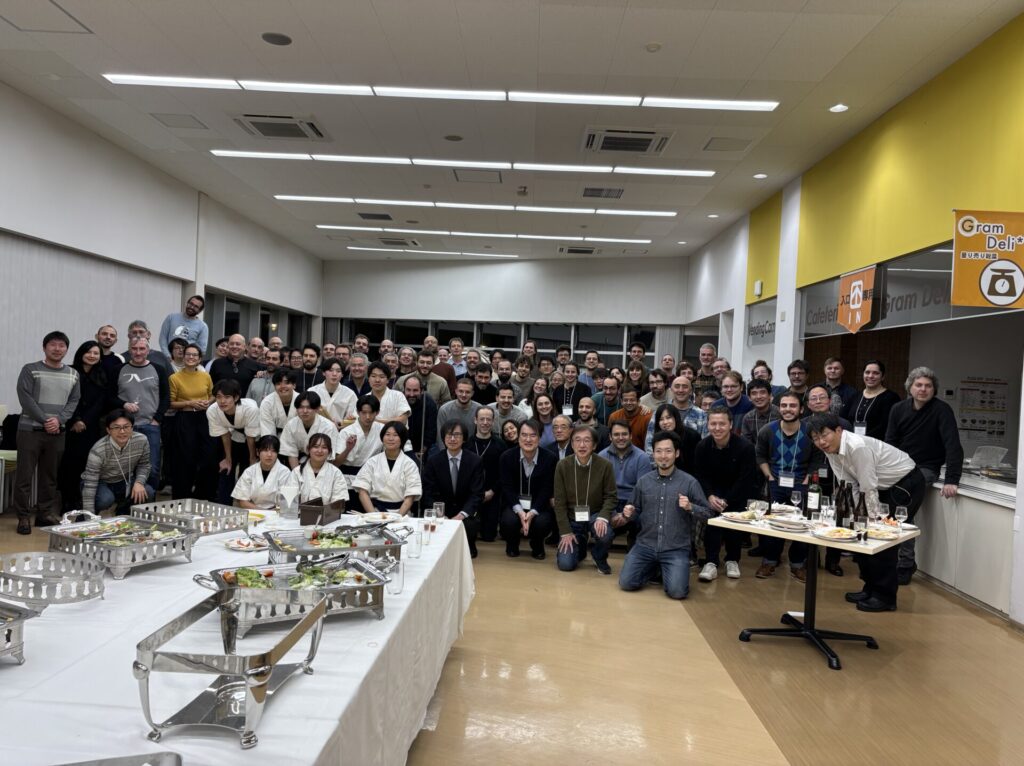
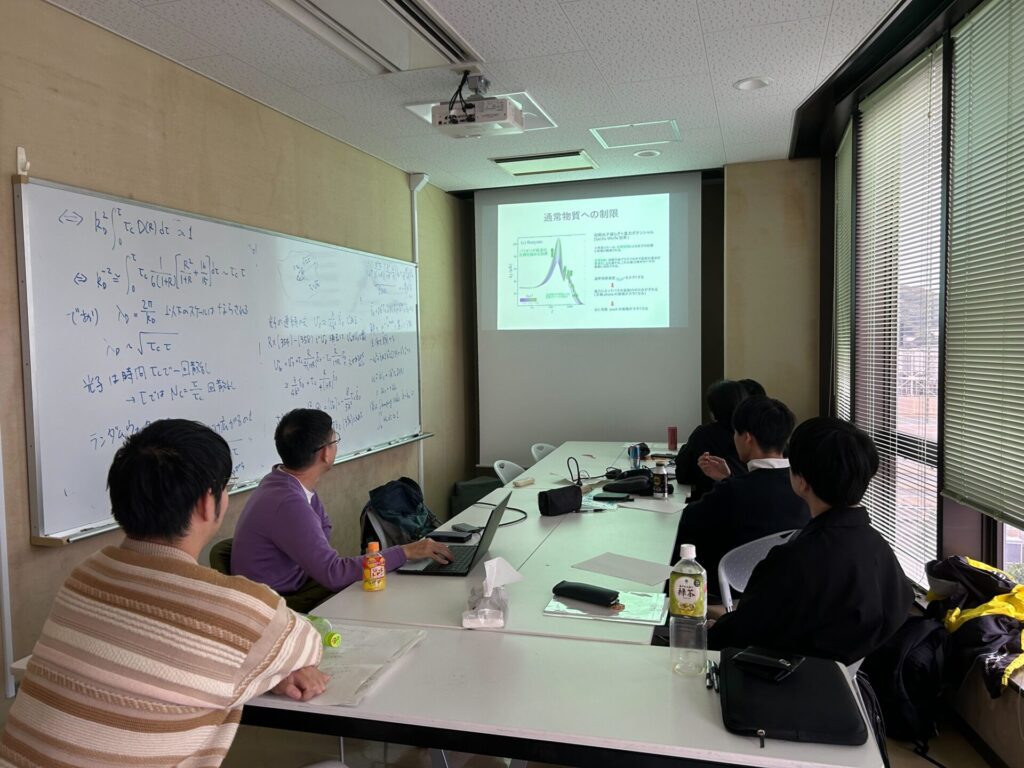
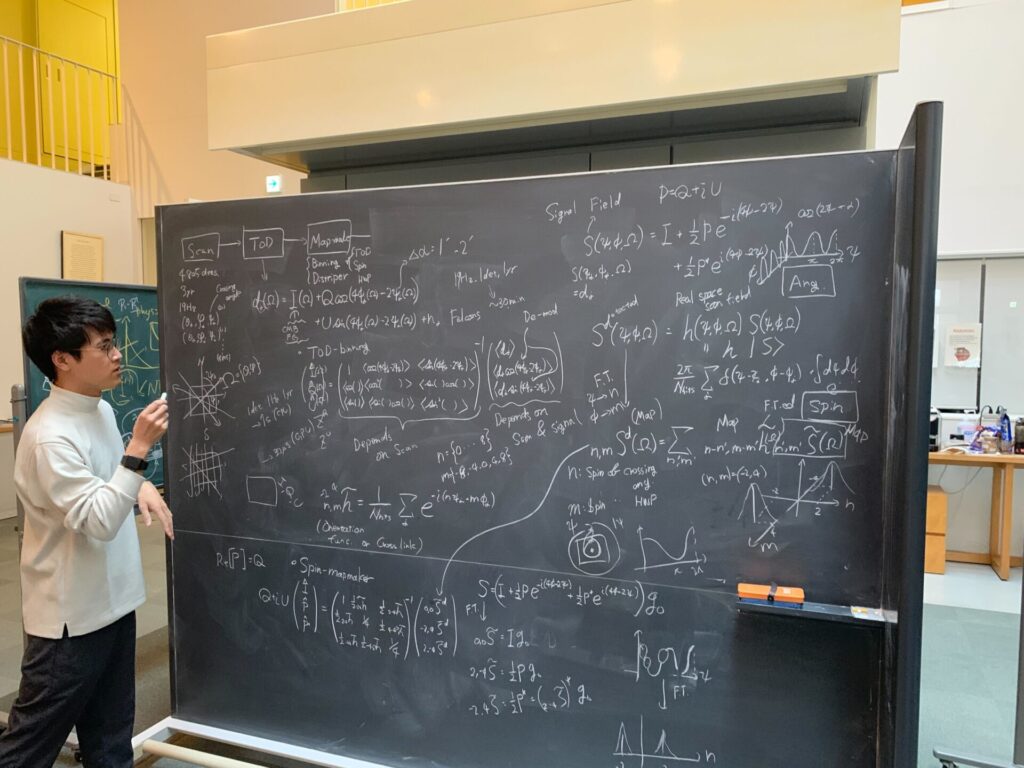
Yusuke/Yuya/Kiyoshi participated in the international workshop CMB B-mode – NEXT held at KEK on January 27-29, and gave invited presentation respectively.
Following the LiteBIRD face-to-face meeting last week, many LiteBIRD collaborators as well as collaborators of the CMB ground-based experiment Simons Observatory (SO) and others gathered for a lively exchange of information beyond the boundaries of collaboration. The following is a list of the participants from our lab.
Kiyoshi Ikuma Foreground Cleaning – Delta Maps Yuya Nagano HWP and systematics effects with asymmetric beams Yusuke Takase Systematic effects mitigation by spin moment decomposition
The LiteBIRD face-to-face (F2F) meeting was held at Kavli IPMU, the University of Tokyo, from January 20 to 24, and Hirokazu, Yusuke, Yuya, and KIyoshi participated. It was the first time in six months since the F2F meeting held in Vancouver in July of the last year, and discussions with the collaborators were enthusiastic.
The banquet held during the meeting included a performance by a Japanese taiko drum band, which was a great moment.
The recent (1/7) press release by Y. Takase et al. titled “How to Capture the Image of the Universe Immediately after its Birth through Satellite Observations” was published in the January 14, 2025 edition of the Nikkan Kogyo Shinbun (25 Science, Technology & University).
The Nikkan Kogyo Shinbun, including back numbers, is available at the Okayama University Library. Okayama University students and the general public are welcome to enter the library. For details, please visit the library’s website.
A scientific paper by Mr. Takase, a third-year doctoral student in our laboratory, has been published in the Italian Journal of Cosmology and Astroparticle Physics (JCAP).
The paper proposes an optimal observation method for future satellite observations to validate inflationary models from polarimetric observations of the cosmic microwave background (CMB) radiation, and provides important guidelines for the design of future next-generation CMB polarimetric observation satellites. This research has been introduced in a press release by Okayama University and in Research Highlights.
Ishino Lab. is in charge of systematic error analysis and scan strategy design for LiteBIRD, a CMB polarimetric observation satellite led by the Japan Aerospace Exploration Agency (JAXA).
LiteBIRD is a scientific project that aims to verify inflation, which is believed to have occurred at the birth of the universe, by observing the polarization of the CMB in the entire cosmic sky with high precision. (For details, please see Research Activities) In order to observe the entire sky of the universe, the satellite will rotate itself at the second Lagrangian point, 1.5 million km away from the earth, to scan the universe (Figure 1).
The key to highly accurate observation of the polarization of the CMB is to suppress systematic errors that originate in the observation equipment. In this study, we found the scan strategy parameters that minimize systematic errors by optimizing the angle and rotation speed of the satellite’s rotation axis.
Figure 1: Conceptual diagram of LiteBIRD scanning the universe through a telescope while spinning. In reality, LiteBIRD performs a complex motion combining three types of rotation: rotation of the spin axis itself i.e. precession, and orbital motion around the sun.
For more information, please see the following press release/Reserch Highlights article.
Paper information Title: Multi-dimensional optimisation of the scanning strategy for the LiteBIRD space mission Authors:Y. Takase, L. Vacher, H. Ishino, G. Patanchon, L. Montier et al., LiteBIRD collaboration DOI: 10.1088/1475-7516/2024/12/036 Link: https://iopscience.iop.org/article/10.1088/1475-7516/2024/12/036
Yuya (Ph.D. student) visited IPMU and studied with collaborators.
They worked on a study of how systematic effects caused by asymmetric antenna patterns on satellites change with and without a rotating half-wave plate.
There are still issues to be addressed and we will continue to work on this topic in the future.
From November 25 to 27, Prof. Jo-Yo Ichikura of Nagoya University visited Okayama University to give an intensive lecture and hold a round-table discussion. The lecture was about cosmology and cosmic microwave background radiation, and the discussion session was titled “Measuring Density Fluctuation of the Universe Twice”, which was interesting in that it is possible to test dark energy by CMB observations without assuming uniform isotropy of the Universe.
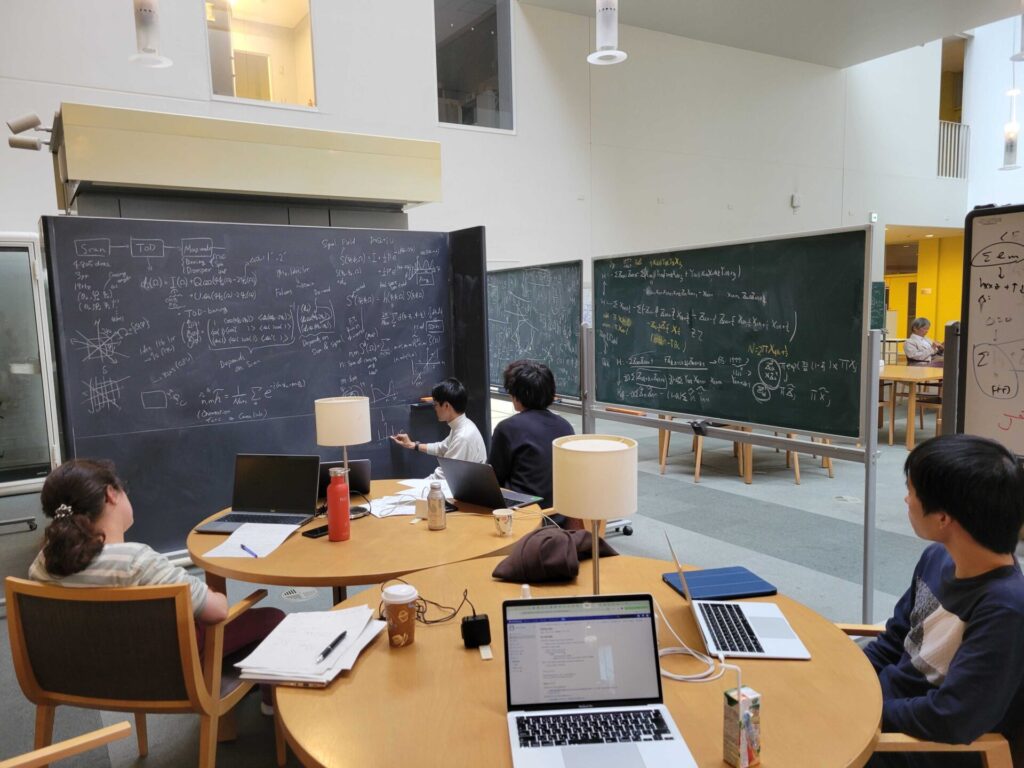
Yusuke (Ph.D. student) visited the Kavli IPMU, University of Tokyo, to work on the systematic error of LiteBIRD with Prof. Matsumura (Univ. Tokyo) and other CMB researchers at IPMU. Patricia Diego (MPA), who is staying at IPMU, also participated in the discussion and greatly contributed to the study of systematic error theory.
Yusuke is working on a theory for fast estimation and suppression of systematic errors that degrades with CMB polarization observations [Y. Takase et al. 2024, arXiv]. IPMU is responsible for the development of the Polarization Modulator Unit (PMU) on the LiteBIRD low-frequency telescope, which will be used to unify systematic effects originating from the imperfection of the PMU. We discussed with students from Matsumura Lab. an analytical method to treat systematic effects originating from the imperfection of the PMU in a unified manner.
The activity is also introduced in the HP of Kavli IPMU CMB group.
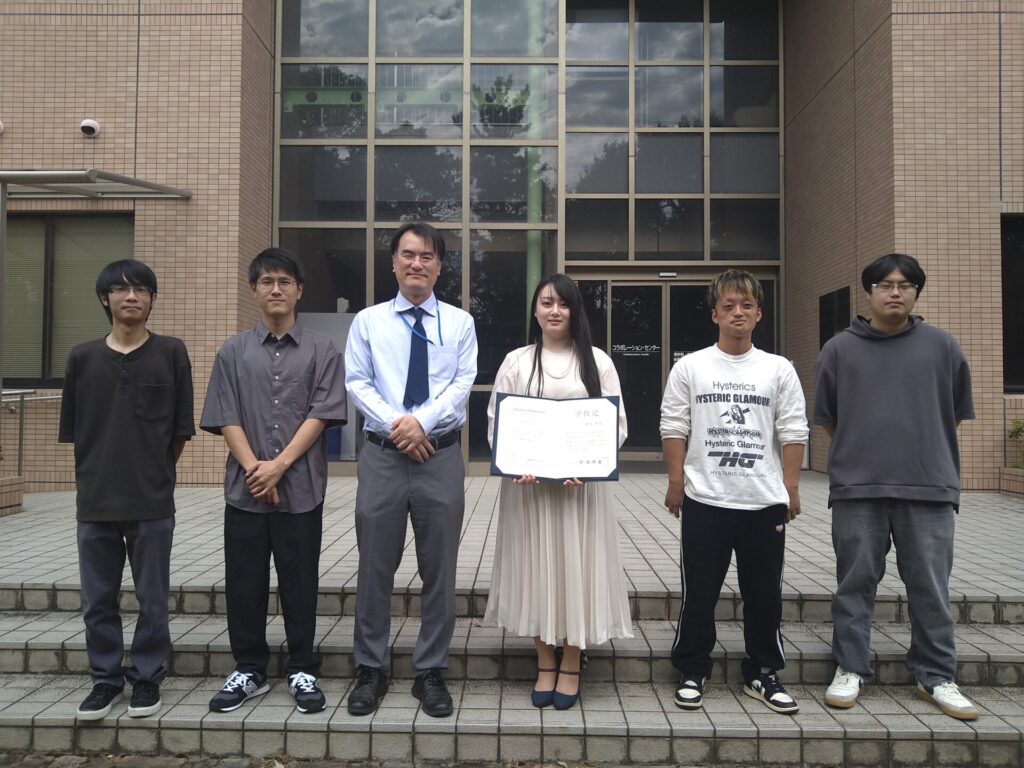
Simon Madrzyk and Correntin Bourdier (Grenoble INP Phelma, France) have completed their 4-month internship since May. Mami Morinaga, a second-year master’s student, has also completed her master’s thesis after a recent presentation!
Mami authored a master’s thesis in LiteBIRD entitled “Analytical computation of systematic errors of detector gain for CMB full-sky polarization observations”. She conducted research on a method to estimate systematic errors faster than commonly performed time-ordered data analysis by analytically treating systematic errors using advanced mathematics. She will be employed by a general company in the future, and we look forward to her further success.
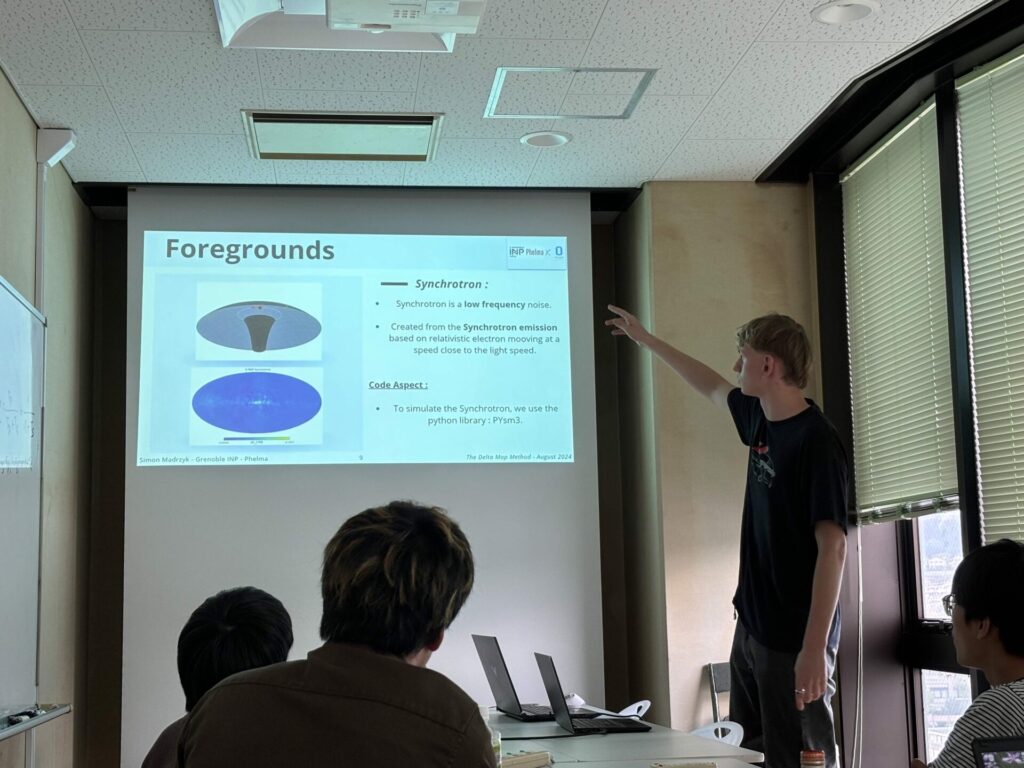
Simon and Kiyoshi (2nd year M.S. student) of our lab worked on “Development of Foreground Radiation Removal for CMB Polarization Observation”, and Correntin and Yuya (3rd year Ph.D. student) worked on “Development of High Precision Polarization Light Source” as internship research.
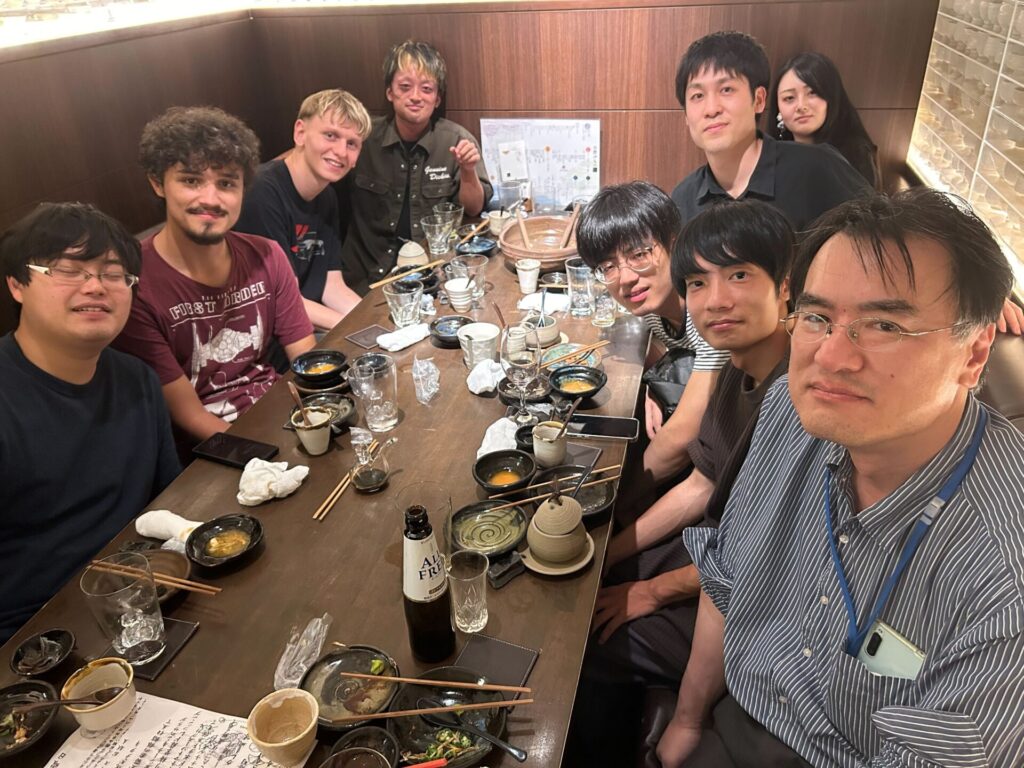
In their final research presentation, they gave a presentation summarizing the results of the four months and deepened the discussion among the lab members. At the end of August, we held a farewell party and had them enjoy Japanese food at an izakaya. We support them both in their future endeavors!
Simon’s final presentation (left) and the farewell party (right)